Fat grafting, also known as fat transfer, is a procedure that uses your body’s own fat to restore volume and enhance contours. Fat is gently removed from areas like the abdomen or thighs using liposuction, purified, and then carefully injected into targeted areas such as the face or breasts. Because it uses natural tissue, fat grafting offers soft, natural-looking results with the added benefit of body contouring in the donor area.
Natural
Your own fat is used for fat grafting. It is moved from one place with an excess to another with a deficiency.
There is no risk of the fat being “rejected.” Your body already recognizes it as part of you, and it will reintegrate without any immune-related issues.
Versatile
Fat grafting is entirely customizable. Fat can be injected for a variety of purposes, including:
Fat grafting alone can be used for augmentation and rejuvenation. In some patients, fat grafting alone may be sufficient to create a volume change. In other situations, fat grafting can be combined with an implant to achieve a more dramatic volume change.
Fat Grafting Before & After Photos
This gallery contains images intended for adult audiences.
To obtain fat (or harvest fat) for fat grafting, liposuction is performed. Usually, whenever liposuction is performed, this fat is thrown away.
Rather than throwing this fat away, it can be saved and used strategically by re-injecting it. Tiny puncture incisions (just a few millimeters wide) are made in hidden areas. Through these incisions, the saved fat is reinjected beneath the skin in areas where added volume is desired.
Model
Fat Grafting Procedure Recovery Process
Recovery from liposuction and fat grafting varies depending on the volume transferred. Most patients can return to work about 1-2 weeks after surgery and resume exercising about 4-6 weeks after surgery.
You should avoid firm pressure on the area that was fat grafted for the first few weeks after surgery. Typically, there is minimal discomfort in the areas where fat is injected. In comparison, the areas of liposuction tend to have a bit more discomfort for 1-2 weeks. This can be minimized with the use of EXPAREL®, a long-acting pain medication that is injected at the time of surgery.
Why Choose Dr. Rodriguez?
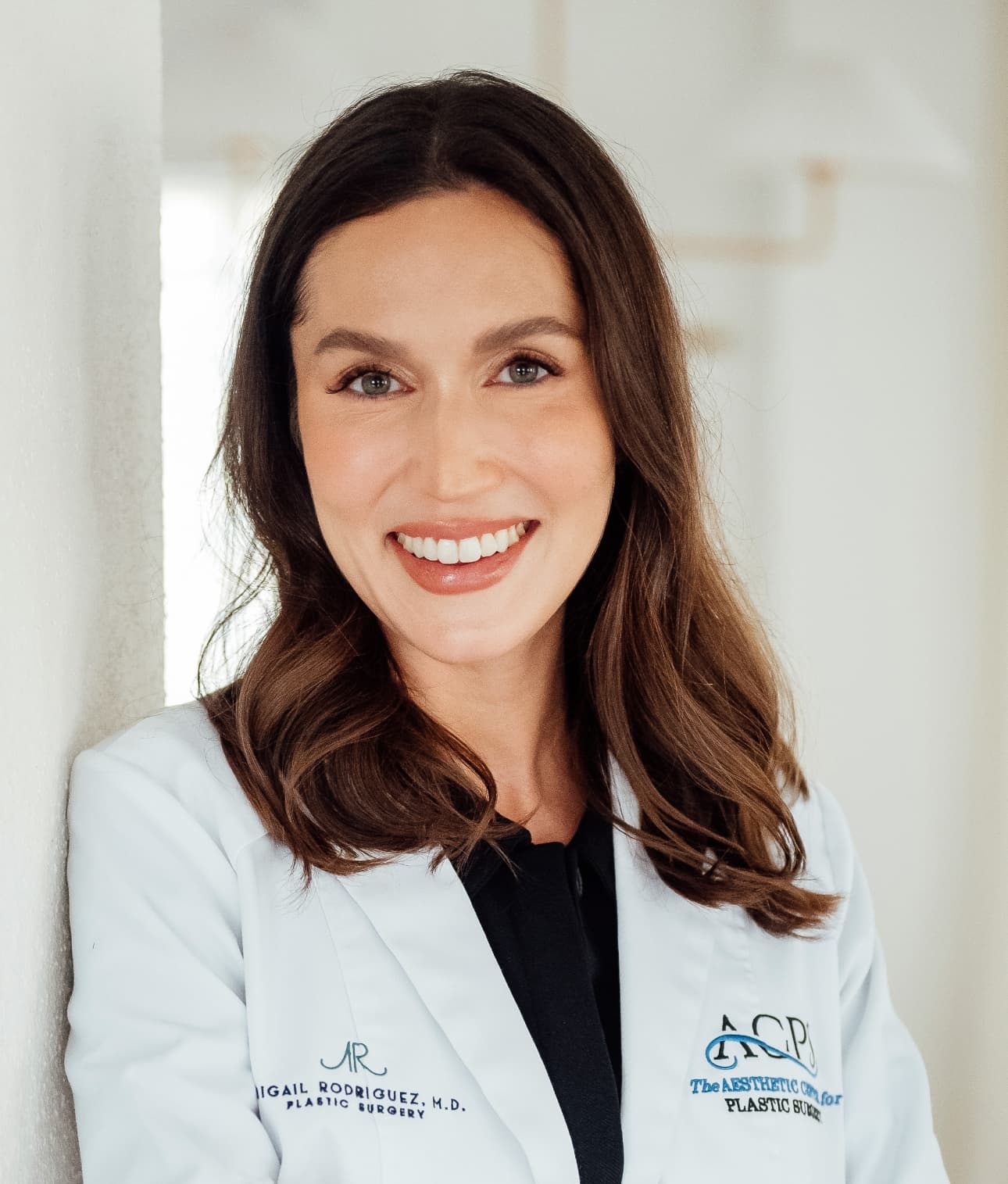
Dr. Abigail Rodriguez blends advanced surgical expertise with refined artistry to create results that look natural, balanced, and enduring. Known for her compassion, transparency, and commitment to patient education and safety, she provides individualized care supported by a state-of-the-art facility, enhanced recovery protocols, and comprehensive follow-up—all designed to ensure you feel cared for, confident, and understood throughout your transformation.
Widely regarded as a top board-certified plastic surgeon in Houston and beyond, Dr. Rodriguez's excellence has been recognized by Newsweek as one of America's Best Plastic Surgeons and by Texas Super Doctors multiple times. She is trusted for her meticulous precision and genuine dedication to helping patients look and feel their most authentic and confident.
After fat is injected into the desired area, your body starts to grow new blood vessels to support the fat cells. This is critical to optimizing the long-term survival of fat.
Over the course of months, your body will gradually lose some of the injected fat as part of the natural healing process. Typically, 40% of the injected fat is lost or resorbed by the body over time. Dr. Rodriguez routinely uses Viality™ or LipoCube to improve the quality of fat and increase the amount that survives.
Due to this slower healing process, you can expect to see your final result from fat grafting several months after surgery.
Model
Flexible Financing For Every Budget
Paying for your procedure shouldn't stand in the way of feeling confident and comfortable in your skin. We offer flexible financing options, including CareCredit® and PatientFi®, to help make your treatment more manageable and accessible.
Our team will guide you through your options and support you during every step of your transformation.
Can extra fat be injected to make up for the fat resorption?
No. Dr. Rodriguez does not advise over-injecting, as this can increase the risk of fat necrosis, oil cysts, and other post-op complications.
If the desired change cannot be safely achieved with a single fat grafting surgery, a second surgery can be considered. This allows fat to be added gradually and gives your body time to develop a blood supply to support it.
Should I gain weight for fat grafting surgery?
No. Dr. Rodriguez recommends that you maintain a stable and healthy weight before and after surgery.
Gaining a significant amount of weight can stretch out your skin, which may not tighten up well after liposuction. Additionally, gaining weight increases the risks associated with anesthesia.
If I am thin, can I still have fat grafting?
It depends.
If the goal is to perform fat grafting in a smaller area, such as the face, it may be an option, as it requires a small volume of fat. Even many thin patients have small areas of fat that can be liposuctioned for this purpose. Most commonly, the inner thighs or flanks can hold onto stubborn fat, even in thin patients.
If the goal is to do fat grafting to a larger area, such as the breasts, then fat grafting may not be an option. Implants may be a better option in thin patients. Or, if only a mild change is desired or acceptable to the patient, then fat grafting can be considered.
Can fat grafting to the breast give me the same result as a breast implant?
No. Typically, the volume change achievable with fat grafting to the breasts is mild. This usually translates to an increase in volume that is less than a cup size.
Dr. Rodriguez may recommend combining fat grafting to the breasts with breast implants. Fat grafting enhances cleavage and fullness at the top of the breasts.
How does fat grafting help with hand aging?
The back of the hands are often overlooked in skincare treatments and can be a “giveaway” of how old you are. The hands often lose fat over time and the skin thins, making them look aged. Injecting fat into the back of the hands can help address these issues.
For many patients, volume loss in the face is the most dramatic change noted with aging. Skin looseness and other changes certainly contribute, but volume loss cannot be ignored when planning facial rejuvenation surgery.
Why is fat important for facial rejuvenation?
In particular, the fat at the midface often dies or droops downwards over time. Strategic fat grafting to the face can help restore what was lost, often in conjunction with other procedures such as a facelift.
A Reputation Built on Results
Hace seis semanas me realicé una abdominoplastia y un aumento de senos con la Dra. Abigail Rodríguez,...
Aracely Benitez
Dr Rodriguez is so kind and honest with her assessment. I also appreciate the efficiency of the office.Everyone...
Gini Crawford
Thanks to Dr. Abigail Rodriguez. I first met her in 2021 for a small surgery on my forehead, and the...
Carla Daniela Sine
I highly recommend Dr. Abigal Rodrigues with my eyes closed. She is an excellent surgeon—from the very...
Don’t hesitate to contact Dr. Abigail Rodriguez if you’re interested in learning more about fat grafting in Houston. We’re here to help you achieve a look that makes you feel more comfortable in your body.